Design a compliant heat network, end to end.
Technically rigorous hydraulic design, energy modelling, costing and UK standards compliance for district heating - from buildings on a real map to a costed, auditable design, in one workspace.
For local authorities, energy consultants and developers designing UK district heating.
 Click to zoom
The whole feasibility and design study, in one connected model.
Every tab reads from the same network. Change a pipe or a demand and the hydraulics, energy balance, carbon, cost and compliance checks all re-compute - no re-keying, no drift between spreadsheets.
Pick any tab to preview it - the same worked example, seen thirteen ways.
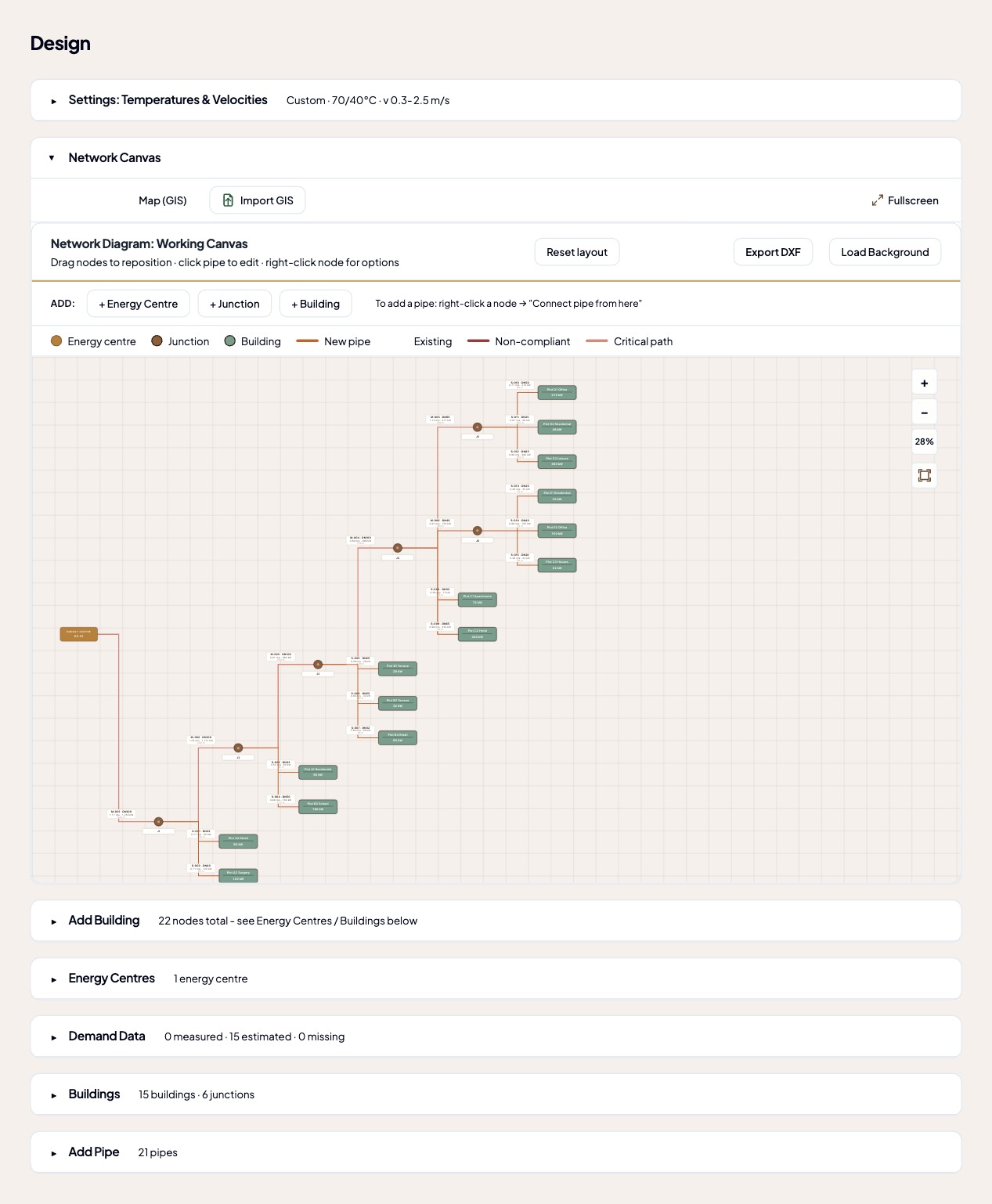
Schematic canvas: place the energy centre, junctions and buildings, then size every pipe with CIBSE CP1 hydraulics.
Start on a real map. Let the network route itself.
GIS-integrated design & auto-routing
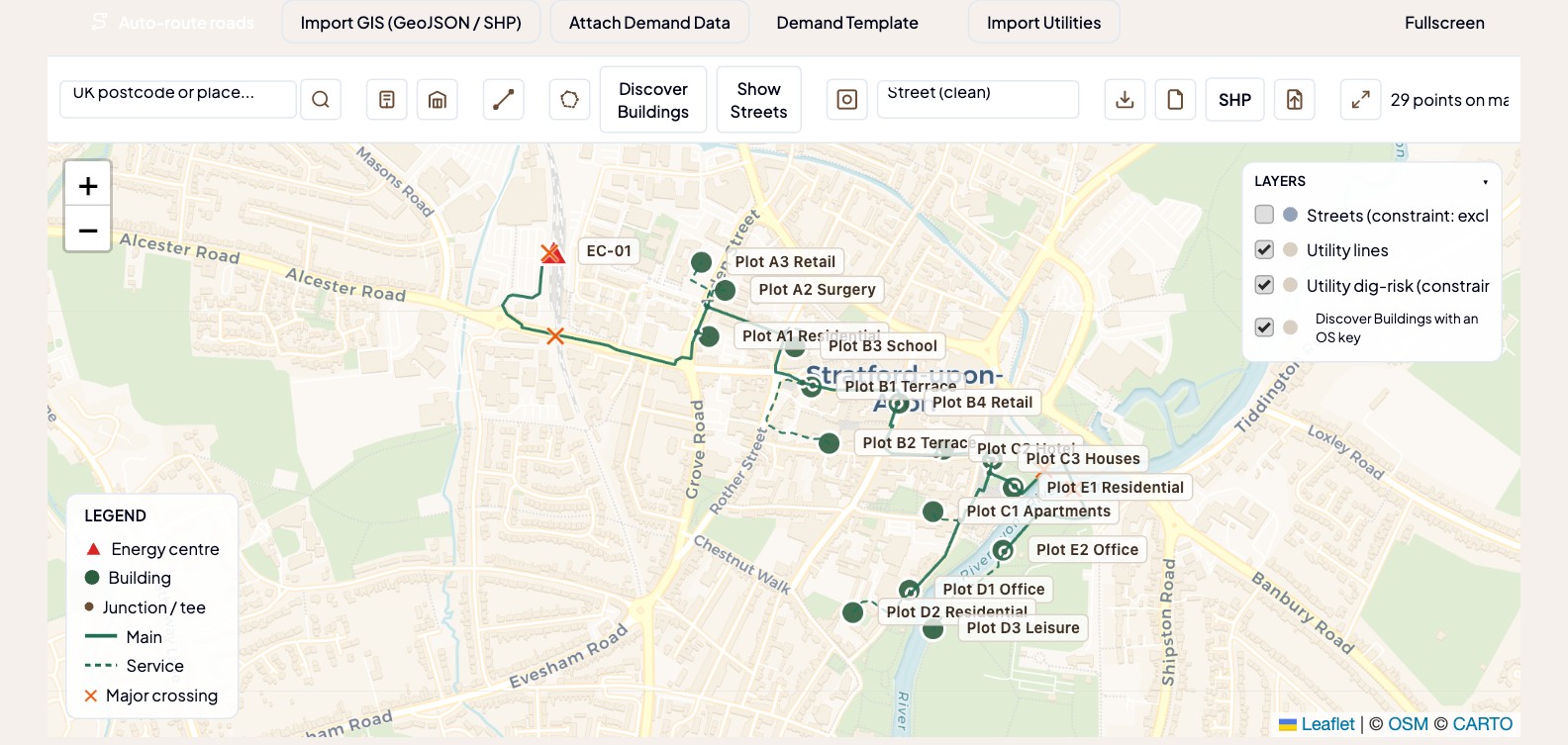
Drop your energy centre and buildings onto Ordnance Survey or OSM basemaps - or import a GeoJSON / shapefile straight from QGIS or ArcGIS. HeatNet lays a shared-trench network that follows the actual streets, sizes every pipe, and measures real trench lengths.
- ↳Auto-route mains and services along real roads, with junctions and tees placed automatically
- ↳Discover buildings and pull demand estimates; attach measured demand by ID or location
- ↳Flags existing utilities and dig-risk crossings so routes avoid the expensive ground
 Click to zoom
Standards-compliant hydraulics you can audit
The engine sizes every pipe with Darcy-Weisbach friction and the Colebrook-White equation, balances looped networks with Hardy-Cross, and applies CP1 diversity and pump sizing. Heat loss follows EN 13941 for pre-insulated bonded pipe.
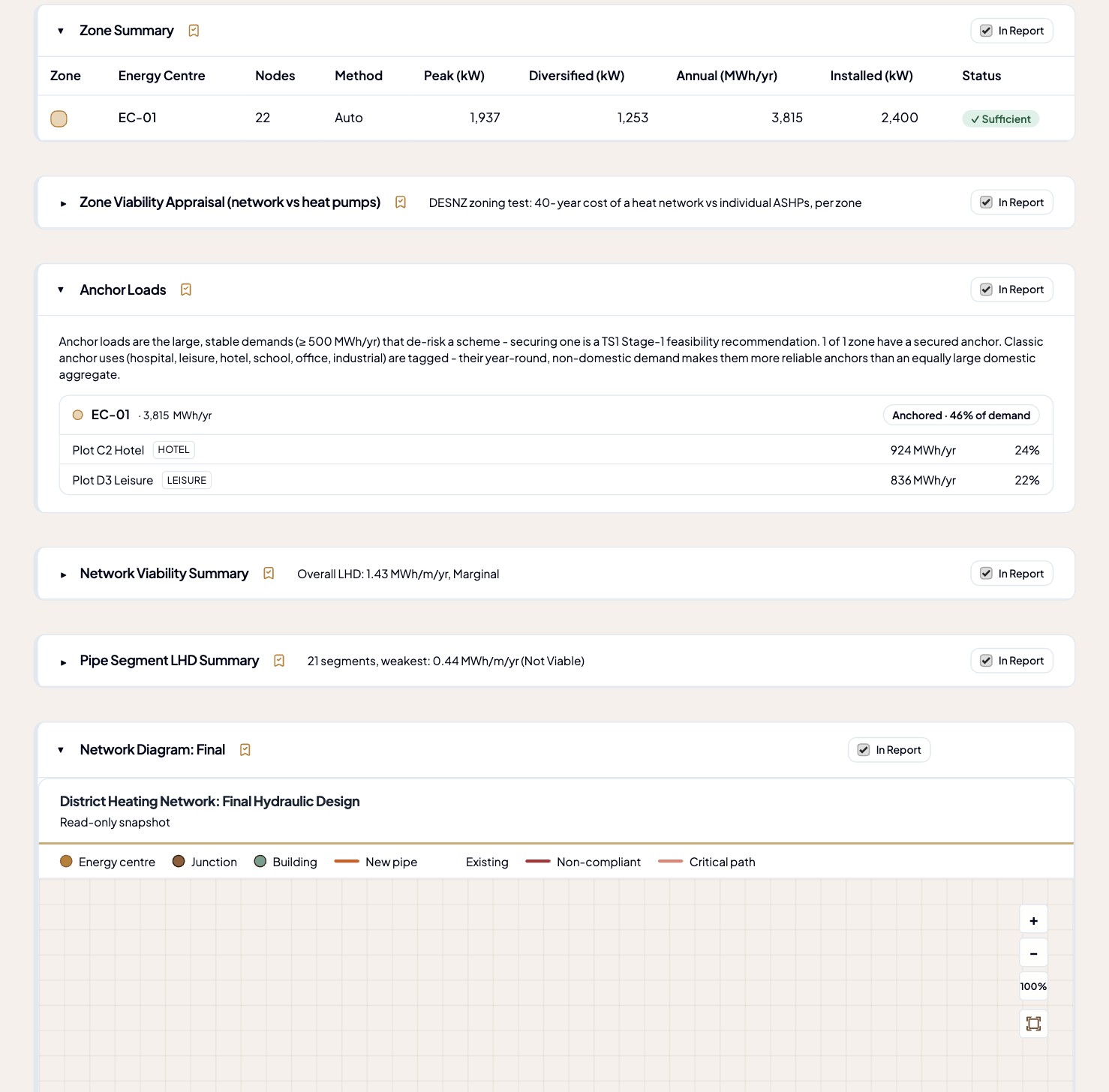
- ✓Per-segment velocity against the CP1 Annex D Table 14 bands
0.5-1.5 m/s to DN50, 0.5-3 m/s above - ✓Zone viability, anchor loads and linear heat density (LHD) appraisal
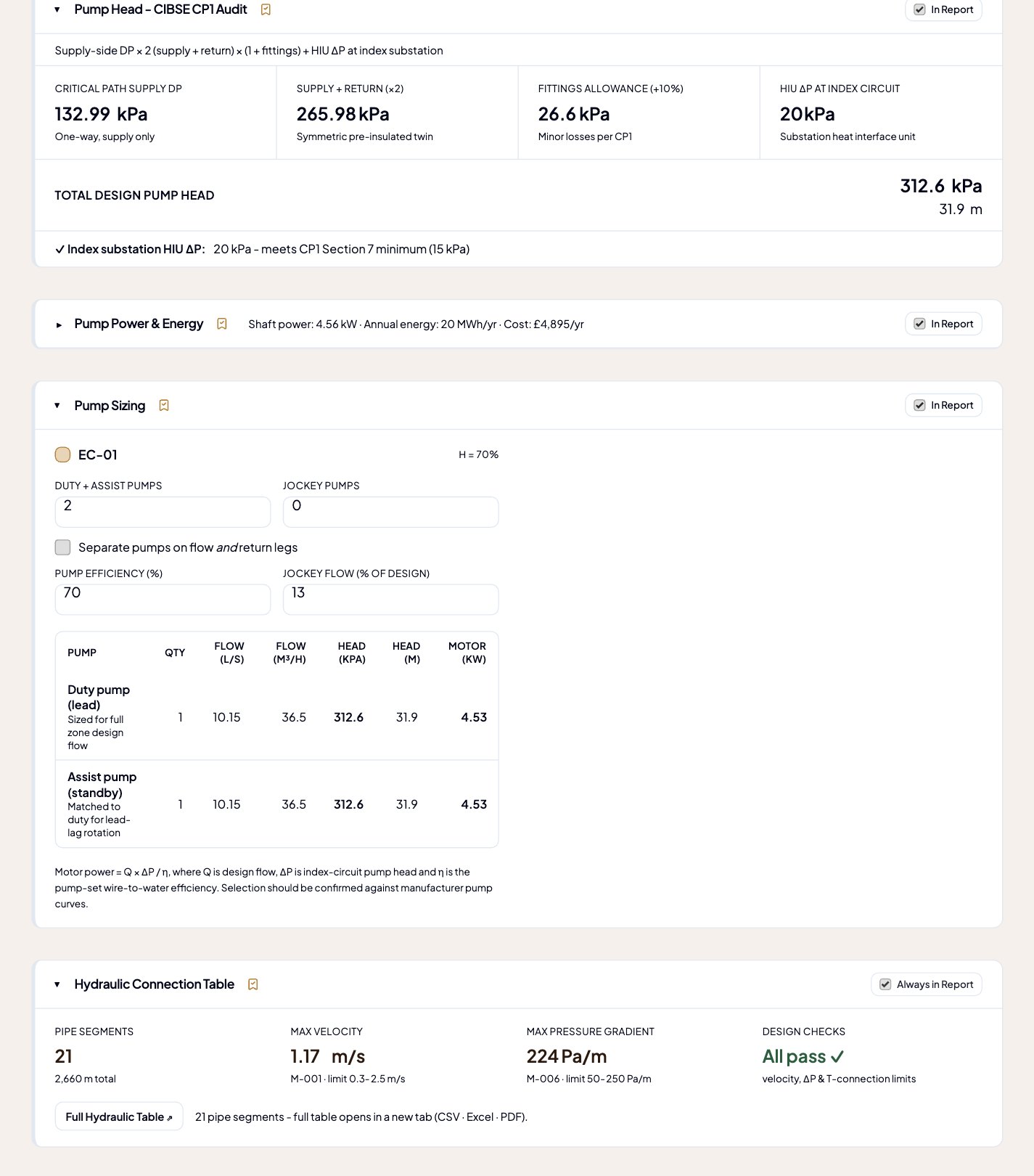
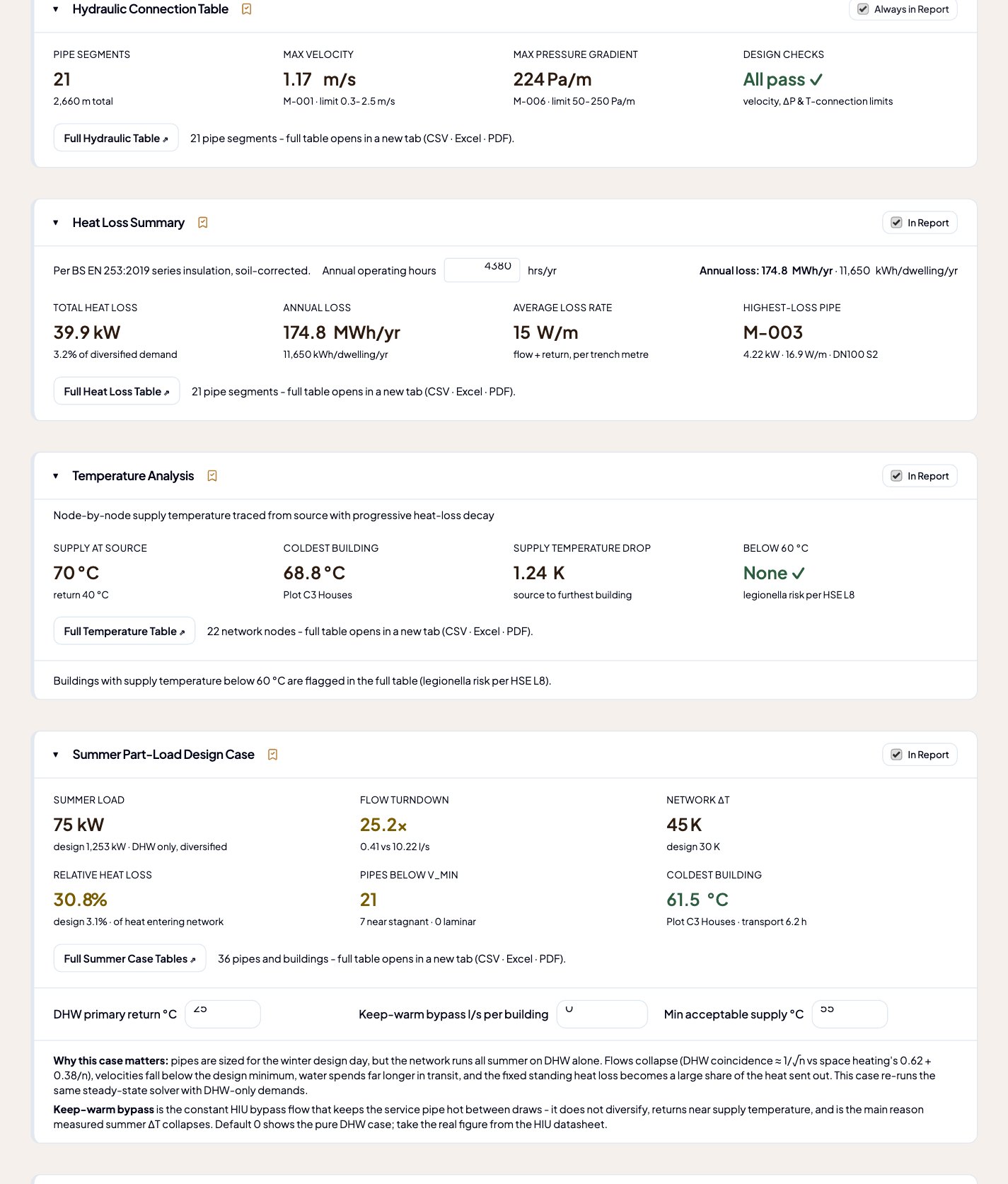
- ✓Index-circuit pump-head audit, network heat loss and temperature drop to the coldest building
 Click to zoom
The complete Analysis tab, your way
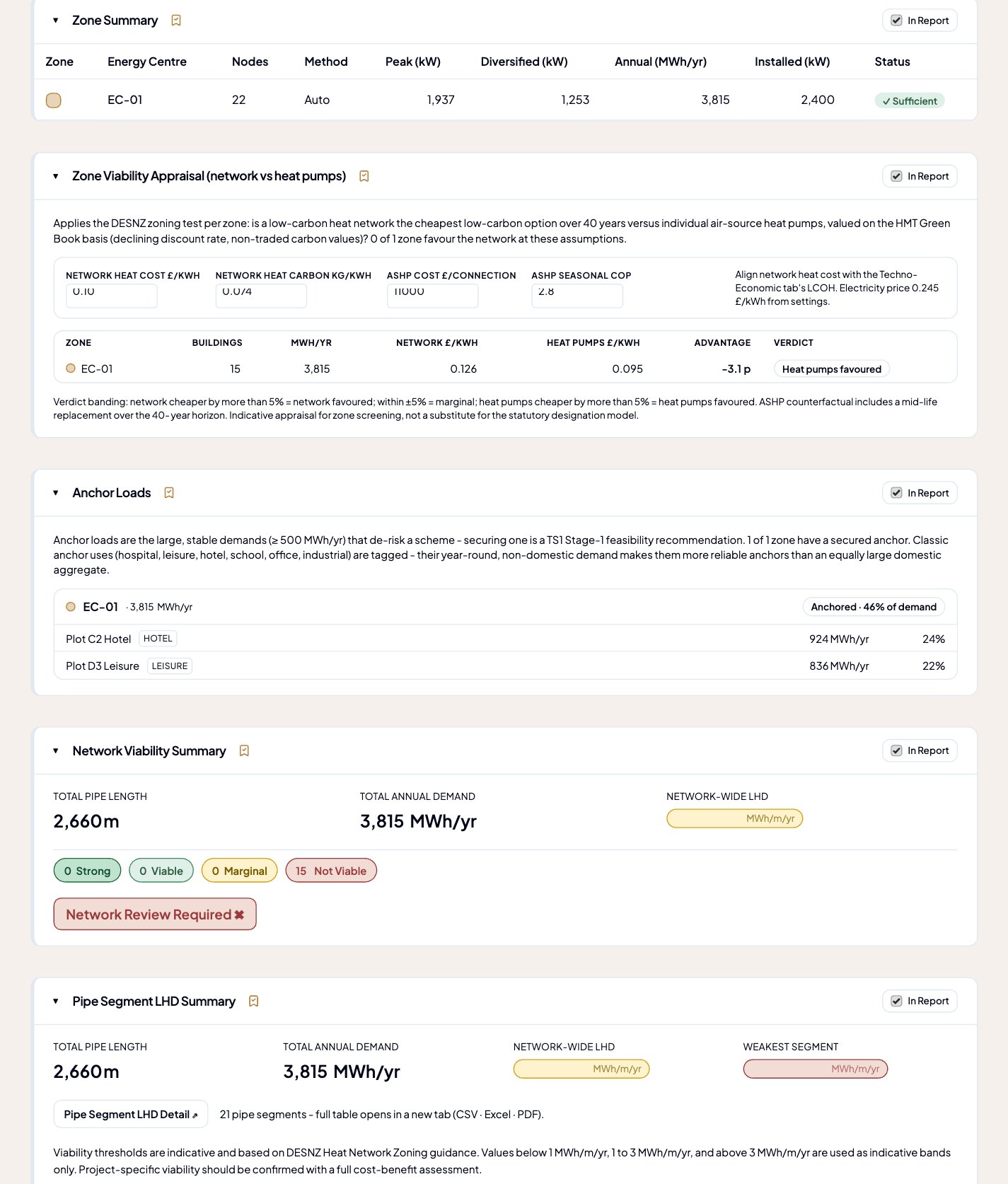
See everything the Analysis tab computes from a single network. Switch between the full tab as one scroll, or broken into shorter sections - each block can be toggled into the exported report.
- 01Zone summary & sufficiency
- 02Zone viability: network vs heat pumps
- 03Anchor loads
- 04Network viability summary
- 05Pipe segment LHD
- 06LHD viability map
- 07Pump head - index-circuit audit
- 08Pump sizing (duty / standby)
- 09Hydraulic connection table
- 10Heat loss summary
- 11Temperature analysis
- 12Summer part-load design case
- 13Diversity profiles
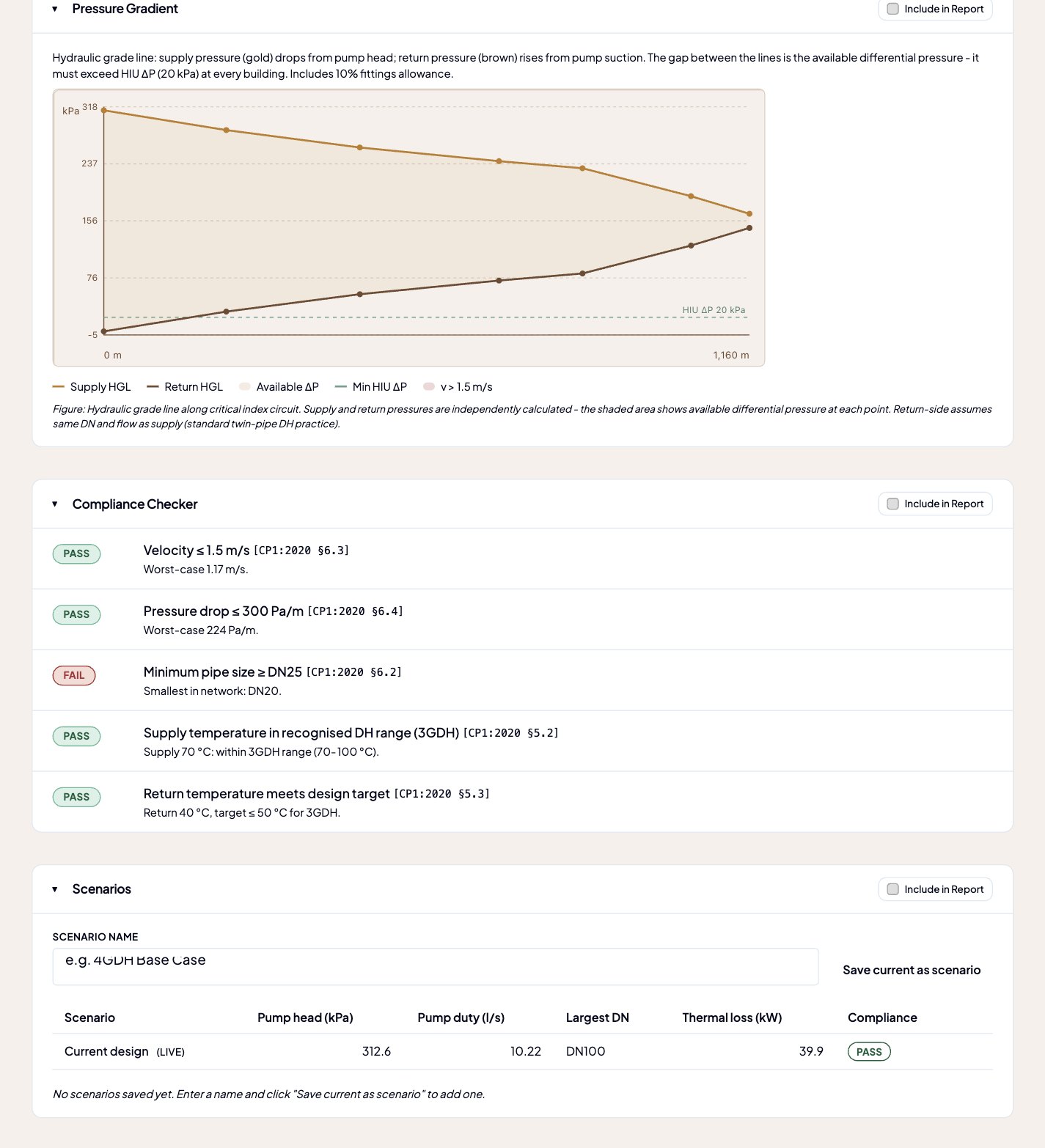
- 14Pressure gradient
- 15Compliance checker
- 16Scenario comparison
 Click to zoom
Scroll inside the panel, or click to open full size.
 Click to zoom
 Click to zoom
 Click to zoom
 Click to zoom
An hour-by-hour picture of the entire year.
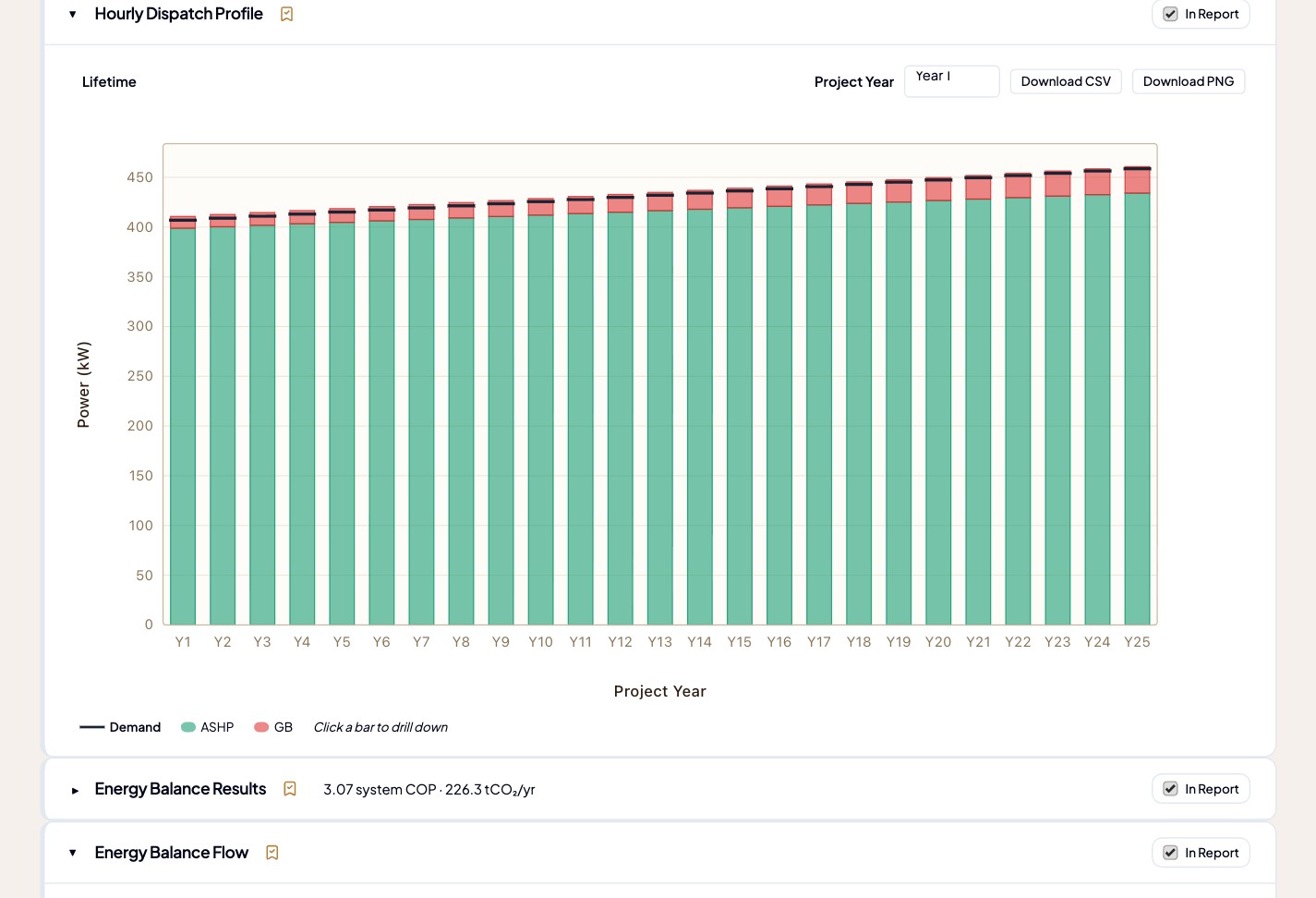
Build a source mix - heat pumps with COP curves, CHP, boilers, thermal storage - and HeatNet runs a merit-order dispatch across all 8,760 hours, then projects it across the 25-year project life.
Full energy balance & lifetime projection
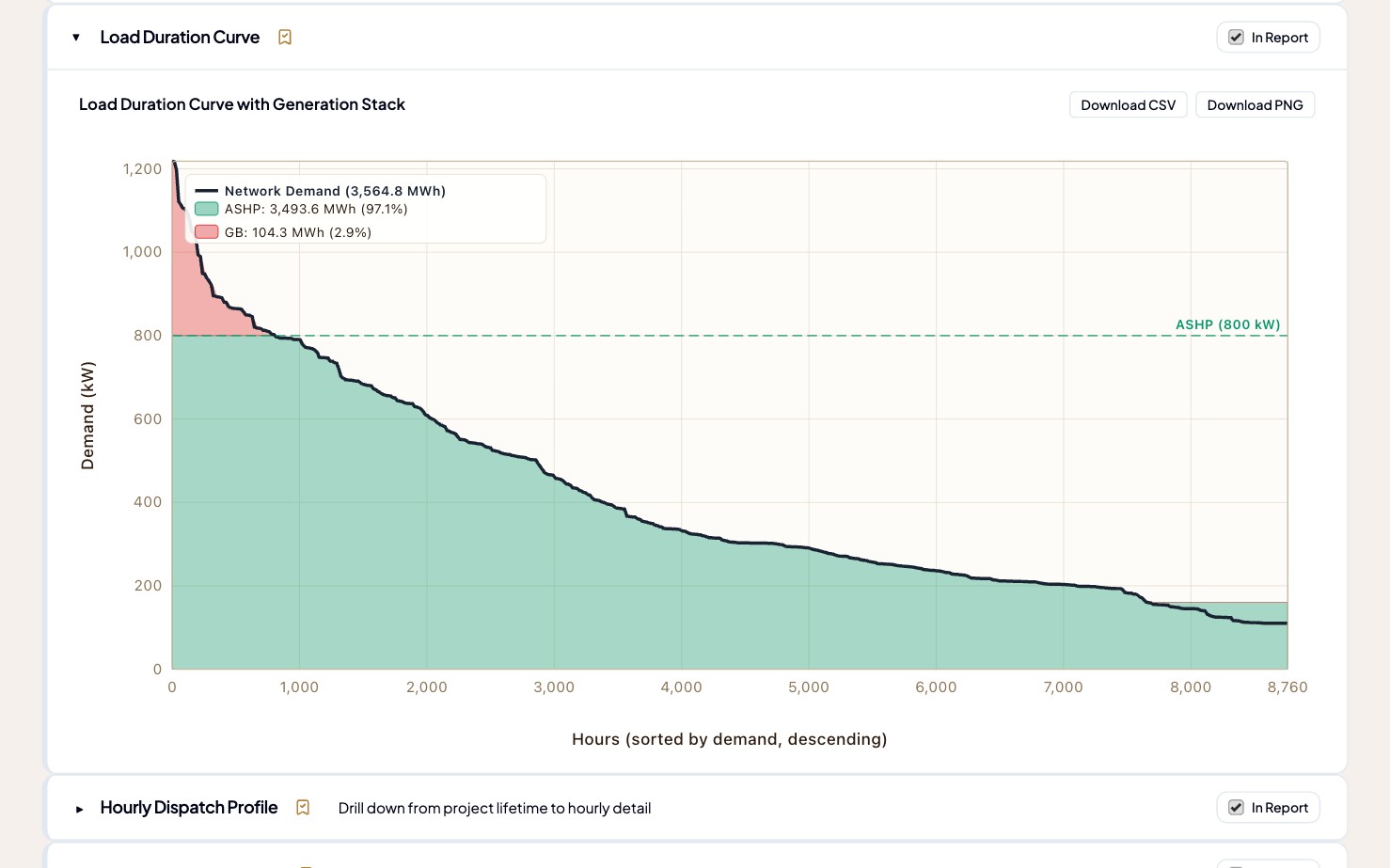
The worked example runs an 800 kW air-source heat pump ahead of a gas boiler: the load-duration curve shows the heat pump covering 97.1% of annual heat, with the boiler trimming the winter peak.
- ↳Load-duration curve with the generation stack split by source
- ↳Degree-day demand profiles, or upload measured half-hourly meter data
- ↳Capacity optimiser searches source splits for lowest cost or carbon
 Click to zoom
 Click to zoom
Carbon, measured against your counterfactual
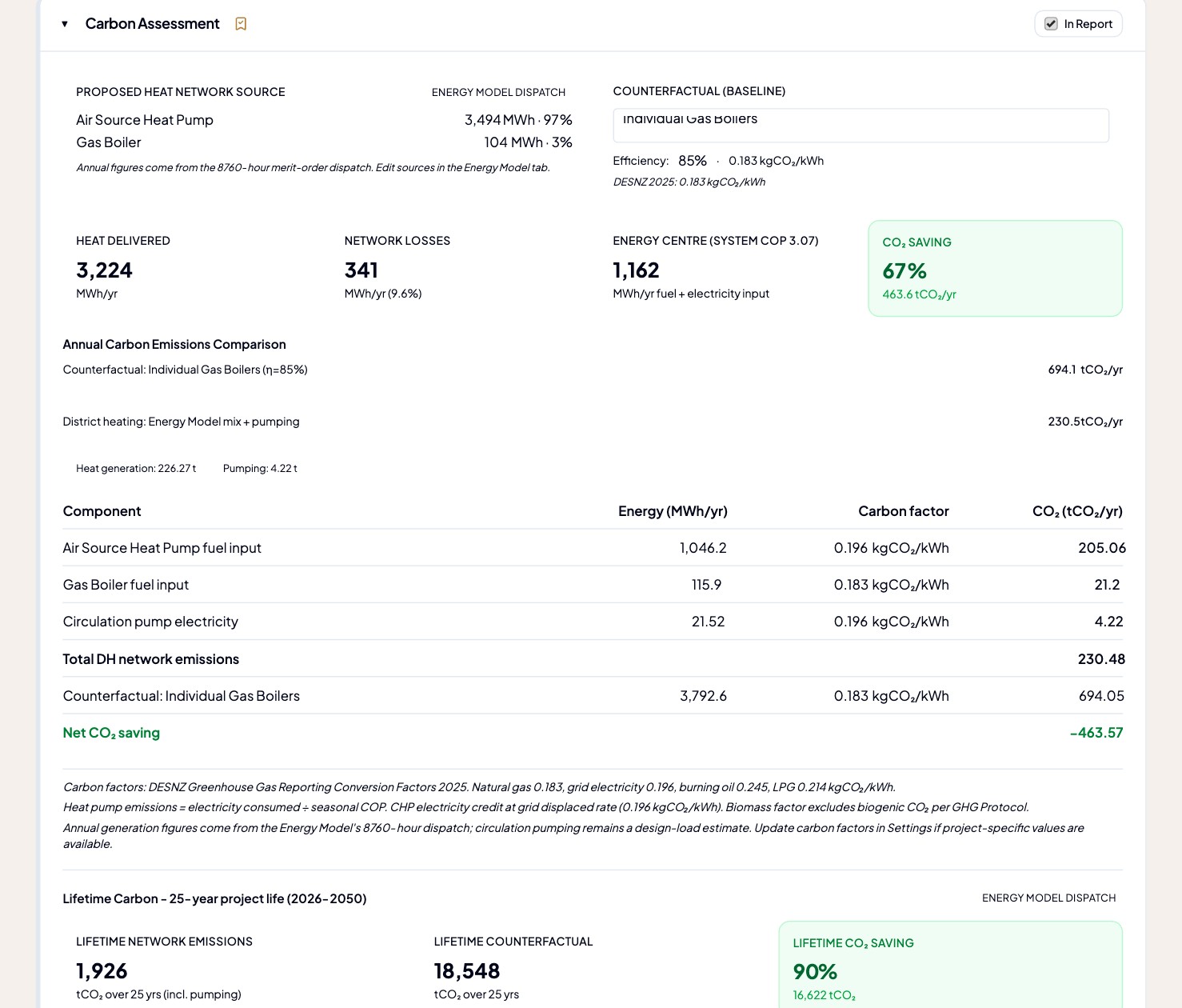
Every annual generation figure flows from the 8760-hour dispatch into a carbon assessment versus a baseline you choose - here, individual gas boilers. The scheme delivers a 67% cut in year-one CO₂ and 90% over the 25-year life as the grid decarbonises.
- ✓DESNZ 2025 greenhouse-gas reporting factors, editable per project
- ✓Component-level breakdown: heat-pump input, boiler input, pumping electricity
- ✓Lifetime carbon over the project horizon with grid-decarbonisation trajectory
 Click to zoom
Techno-economics on screen as you design
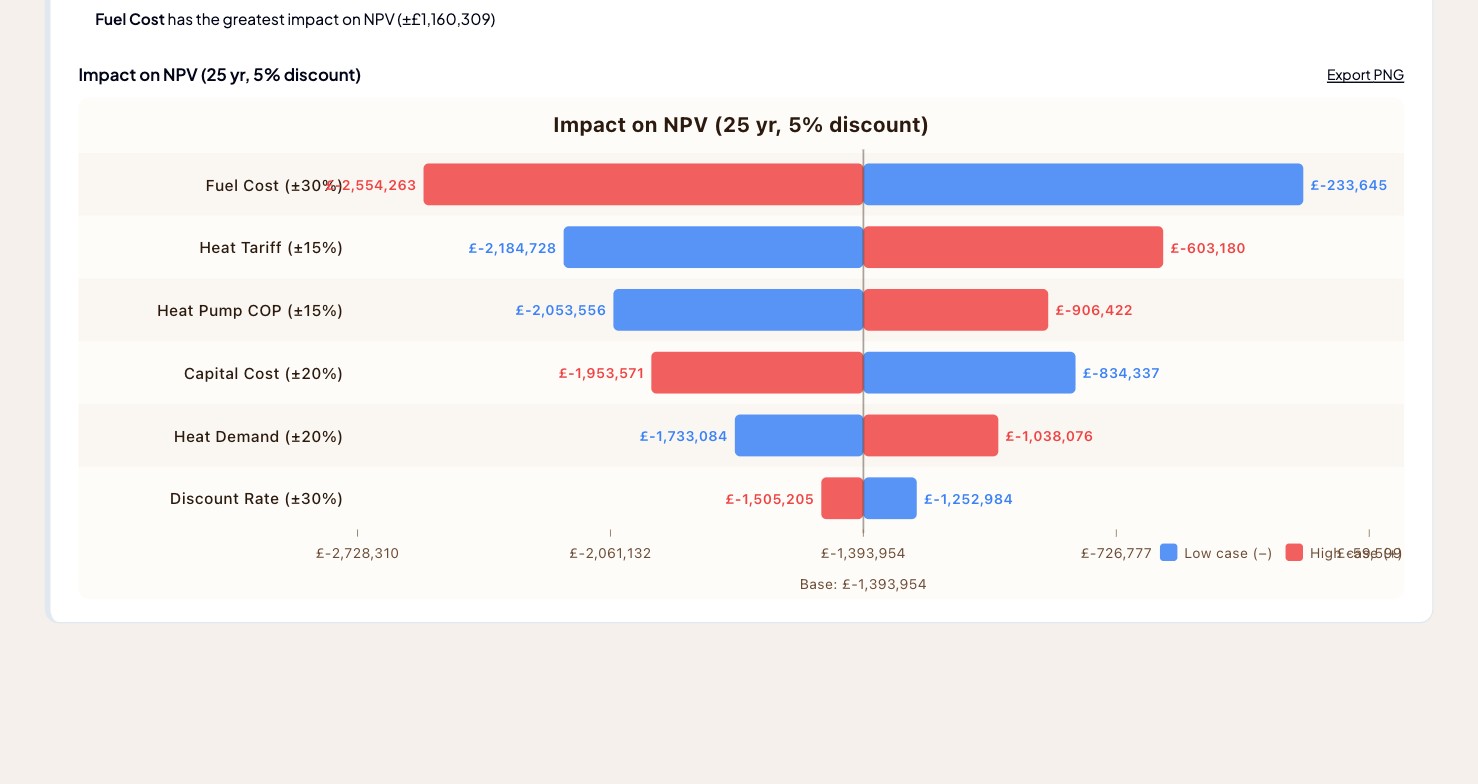
CAPEX and OPEX build straight from the pipe schedule and dispatch. See net present value, levelised cost of heat and simple payback update live - then run a one-at-a-time sensitivity to find what really moves the business case.
- ↳Capital cost breakdown: generation plant, pipework, connections, balance of plant
- ↳Grant modelling, fuel and tariff escalation, discount-rate control
- ↳Tornado sensitivity ranks fuel cost, tariff, COP, capital and demand by NPV impact
 Click to zoom
UK standards checks the model runs for you.
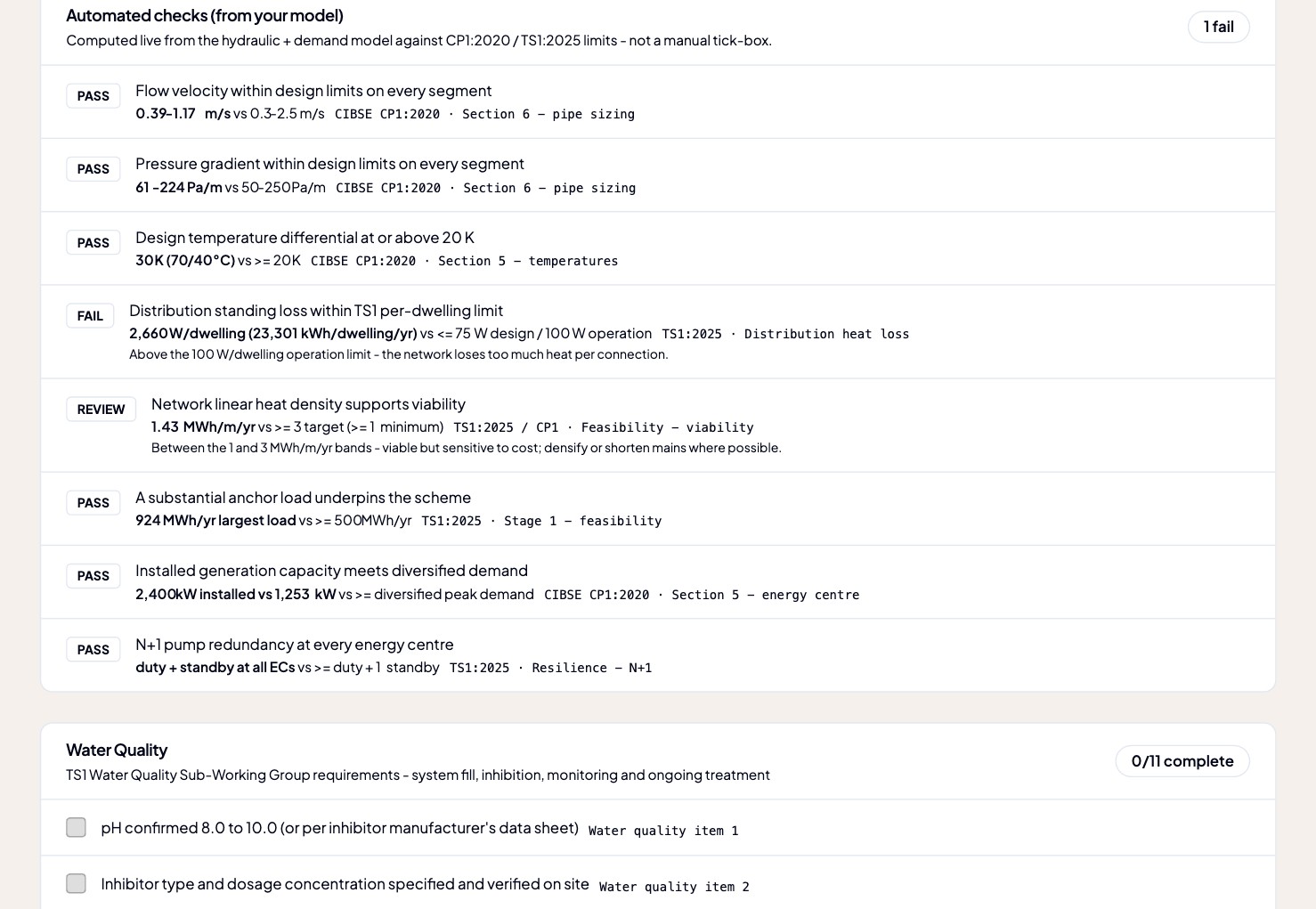
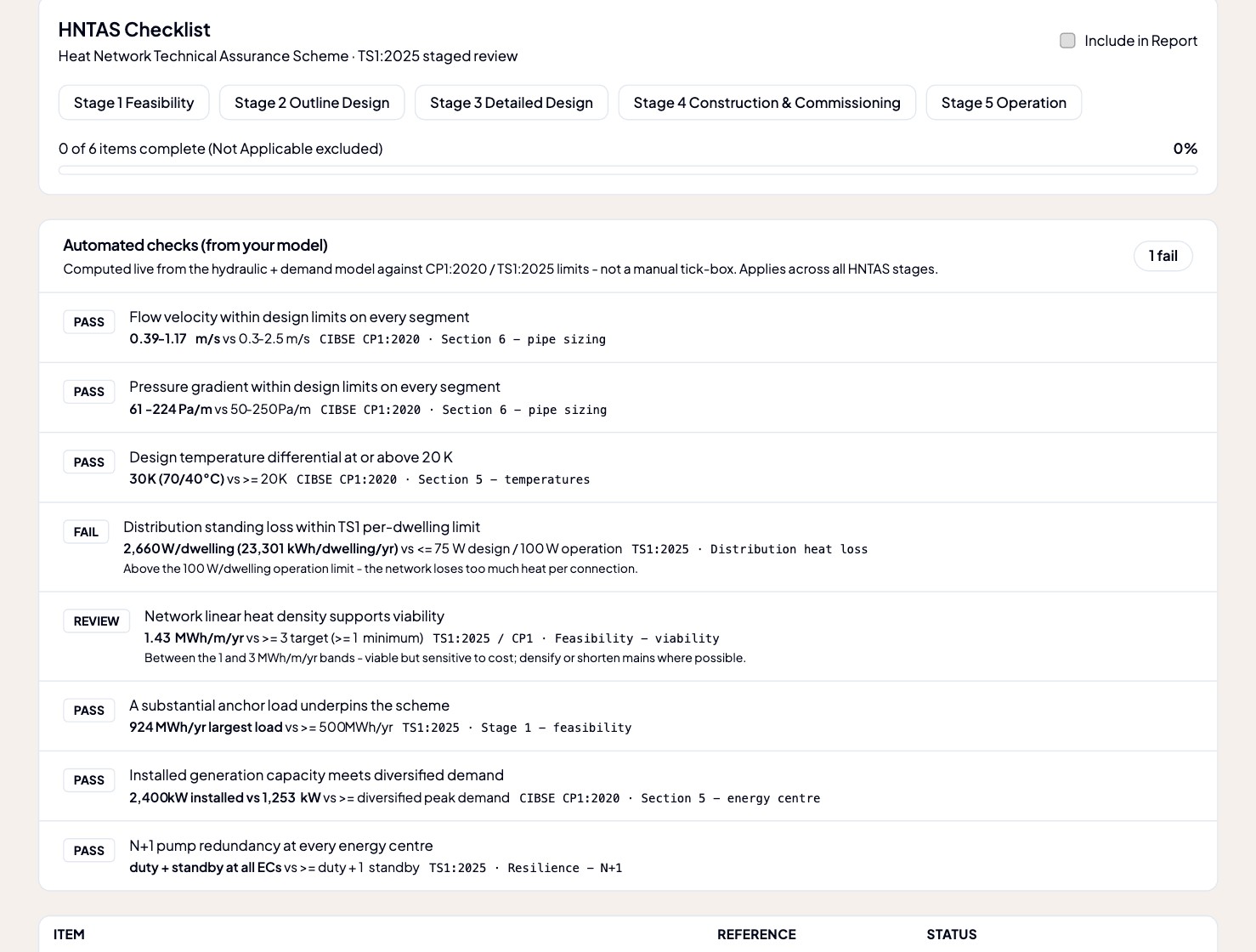
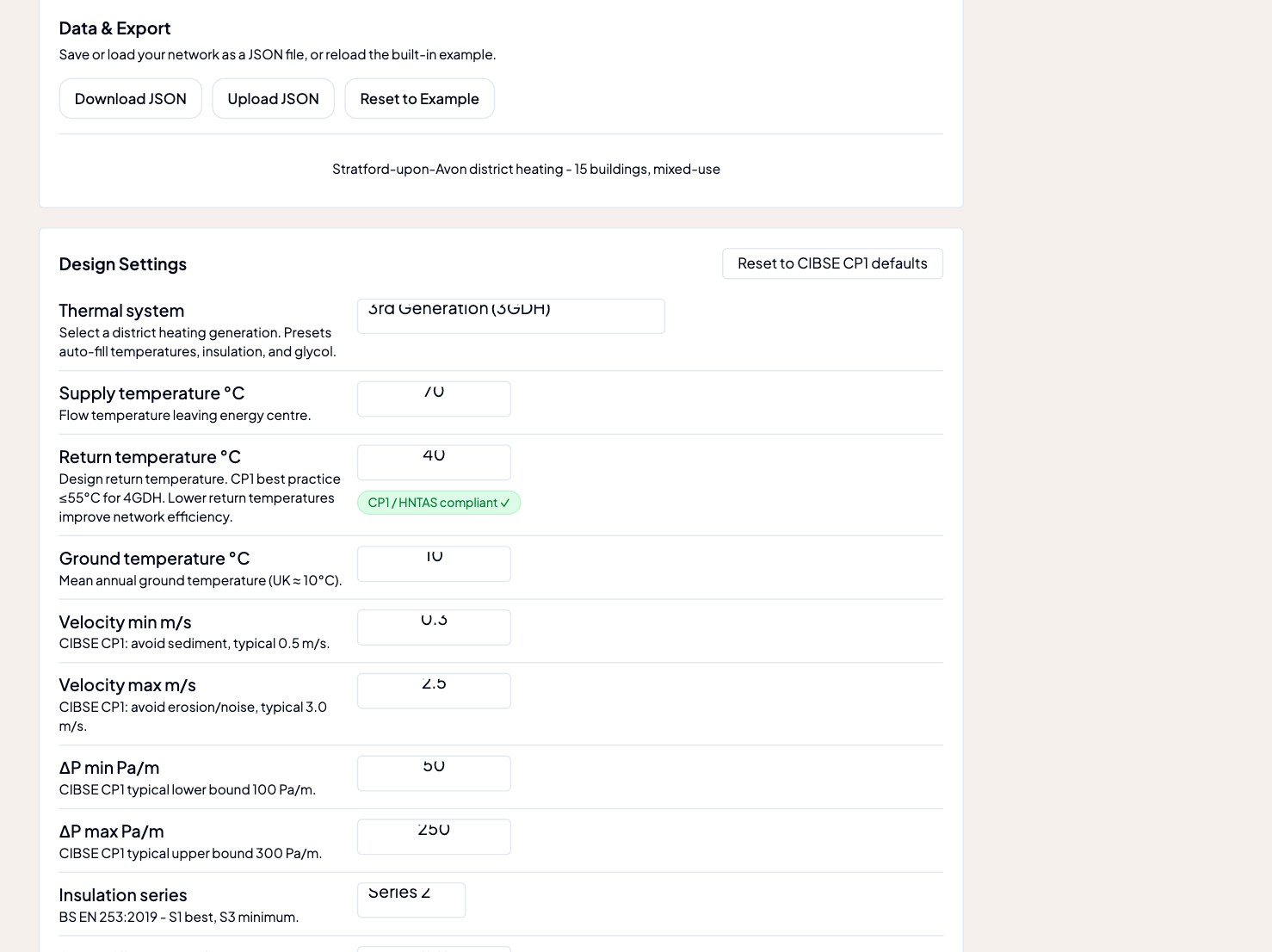
Not a manual tick-box: HeatNet computes design checks live from the hydraulic and demand model against CIBSE CP1:2020 and the draft TS1:2025, and threads them through the HNTAS staged-assurance gates.
 Click to zoom
TS1 & HNTAS, threaded through the design
Each automated check cites its clause and shows the computed value against the limit - flow velocity, pressure gradient, temperature differential, per-dwelling standing loss, anchor load, installed capacity and pump redundancy. The HNTAS view organises requirements across the assurance stages, from feasibility to operation.
- ✓Live pass / review / fail verdicts with the exact figure and threshold
- ✓HNTAS Stage 1 Concept Design items from the draft Phase 1 specifications, element by element
HNTAS Stage 1, element by element
The HNTAS tab follows the stage structure DESNZ consulted on in January 2026: eight stages for new networks and five milestones for existing ones. Stage 1 Concept Design is itemised for each element from the draft Phase 1 technical specifications, with the HeatNet output that supports each item, a scope check and an indicative heat loss per dwelling. The scheme is still in draft and starts in 2027.
 Click to zoom
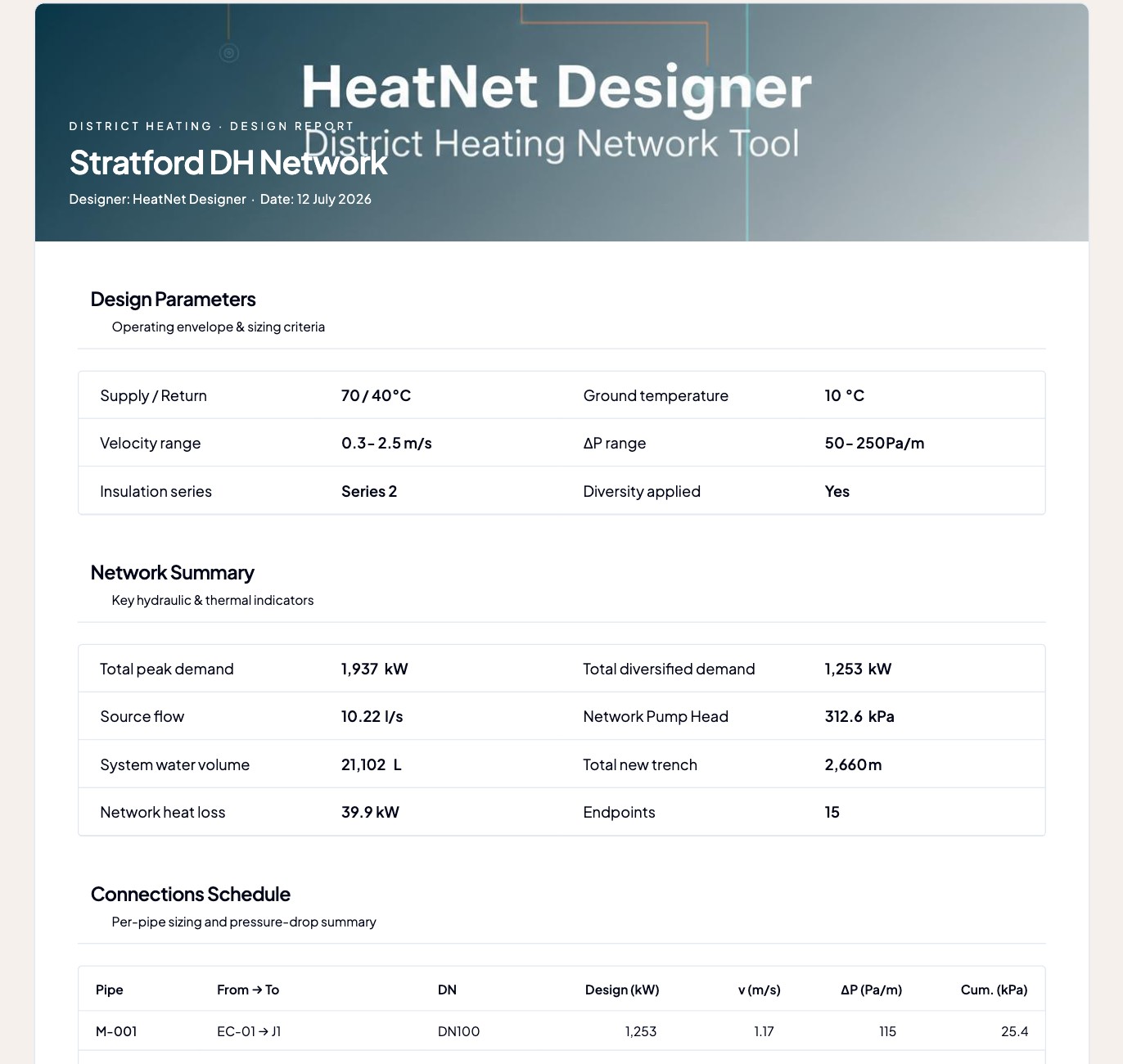
From model to the documents a scheme actually needs.
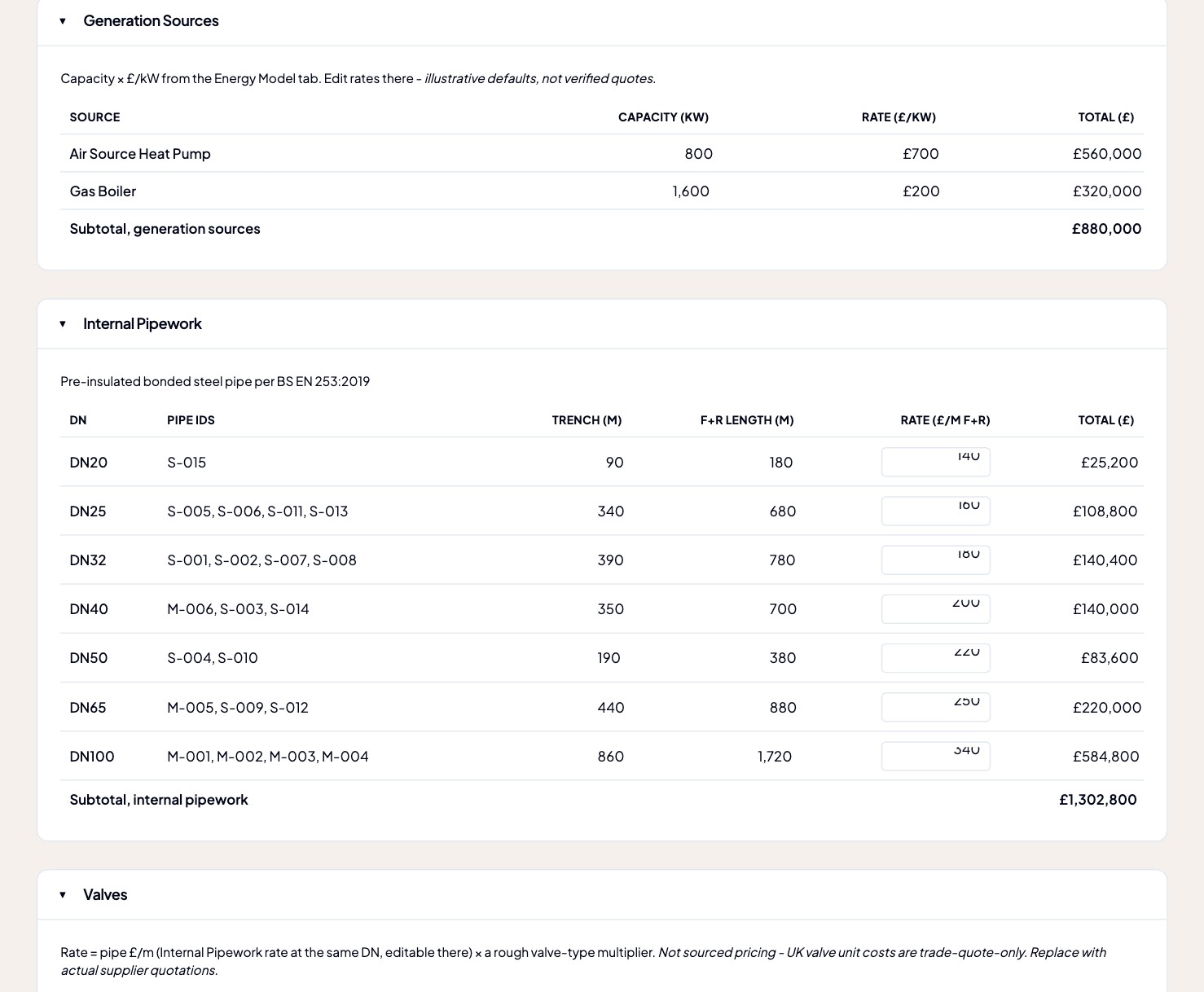
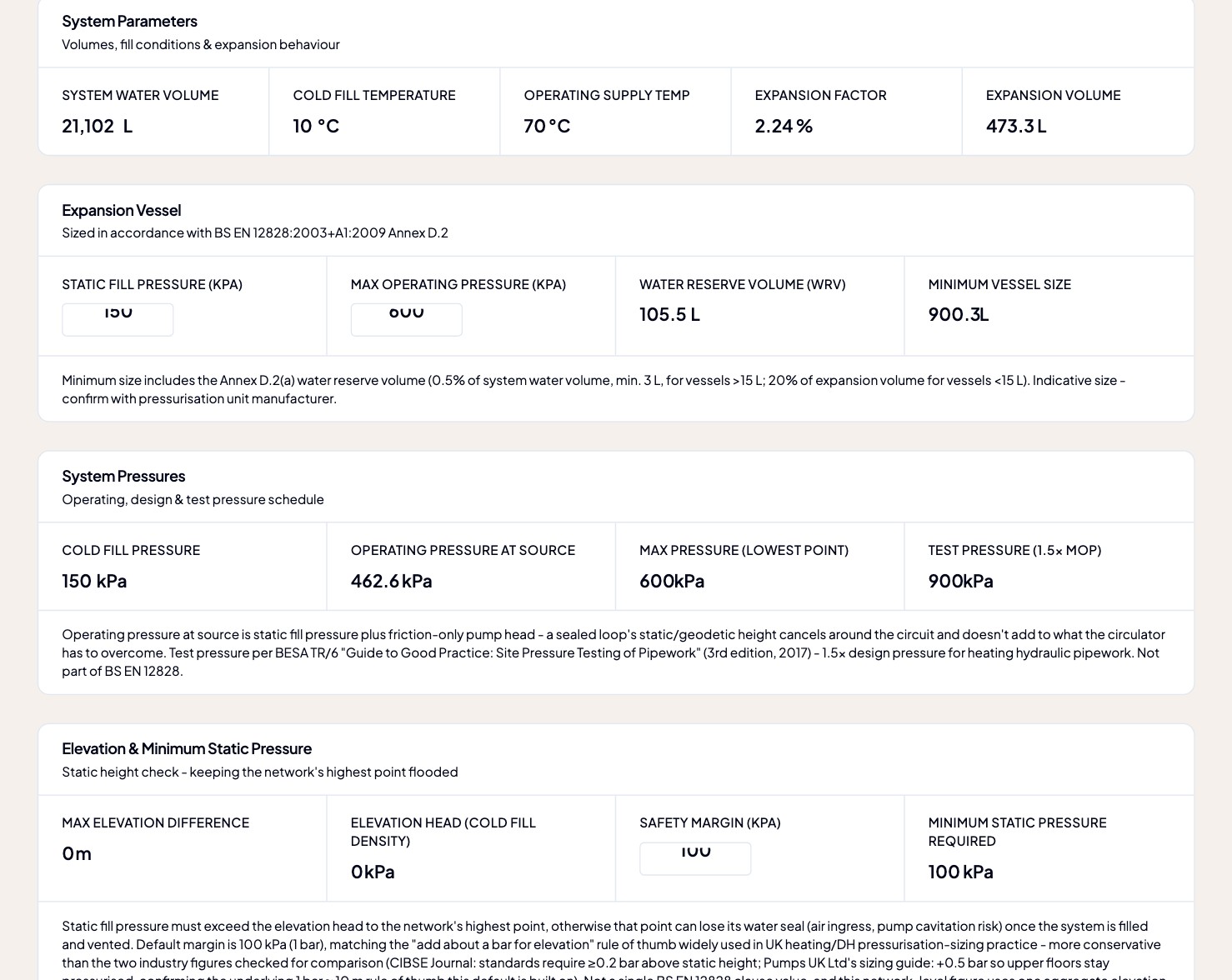
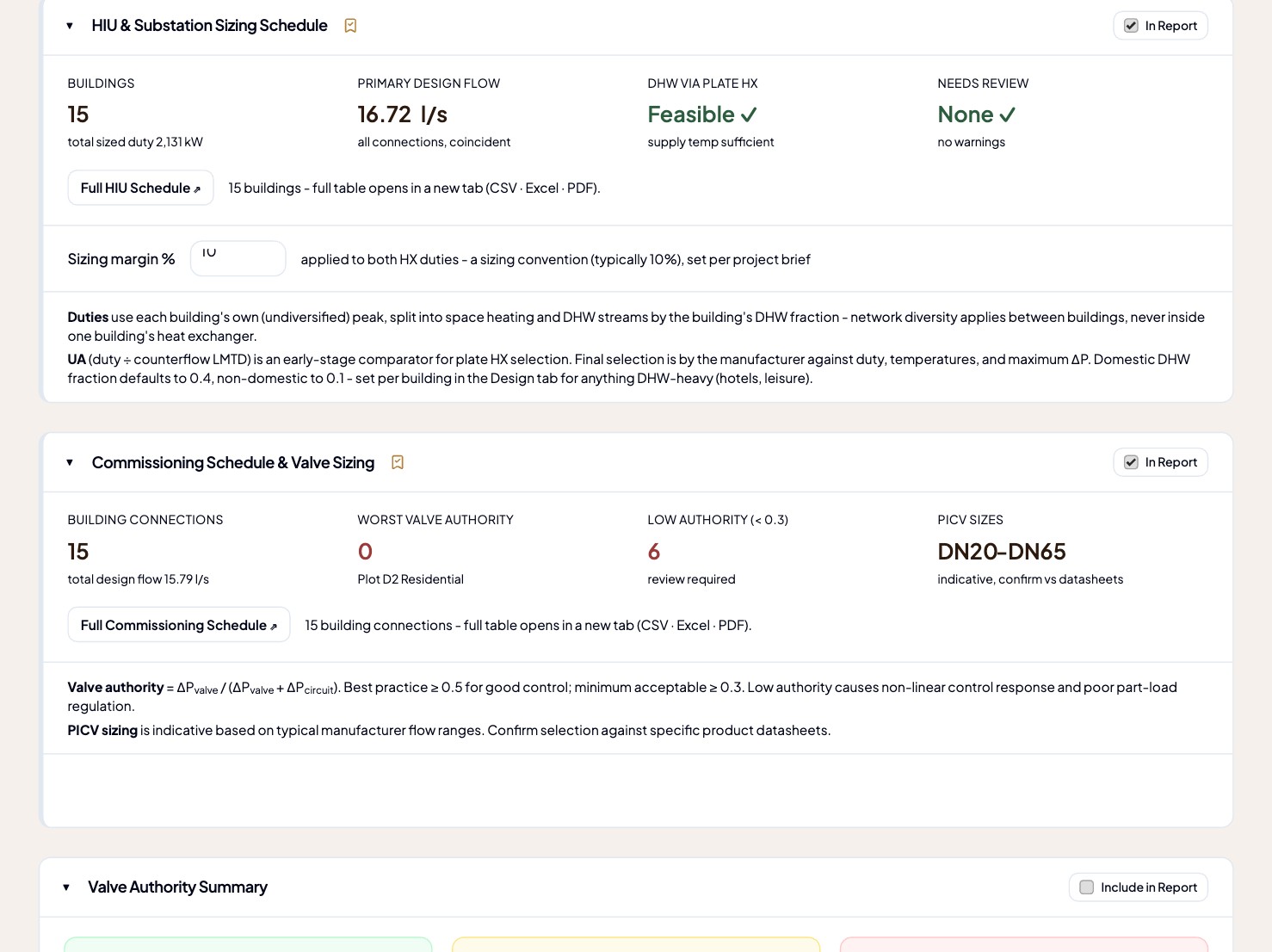
Costing, pressurisation, commissioning and a branded report all draw from the same network - so what you issue matches what you designed.
Built on the codes UK district heating is assessed against.
Put your next scheme on the map.
Go from buildings on a real map to a costed, standards-checked design - all in one workspace.
Free to try - sign in with your email. Up to 500 buildings and 2 saved projects; enterprise and city-scale on request.